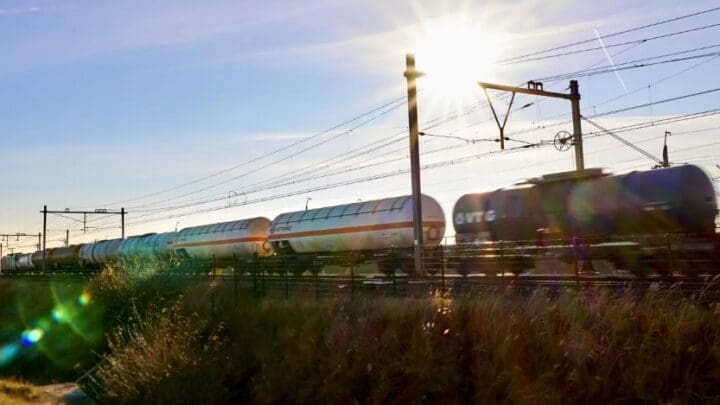
This benchmark shows that carriers from the Netherlands often pay higher infrastructure costs in practice than from neighbouring countries. The difference is mainly due to subsidies provided in Belgium and Germany, but not in the Netherlands.
For the study, six representative routes and types of good (including containers, chemicals and ore) were compared for the years 2025 and 2026. This included looking at train path costs, stabling costs and traction and energy costs.
The gross rates in the three countries are close to each other. The net costs differ because carriers in Belgium and Germany are compensated for part of the infrastructure costs through national schemes.
For example, a carrier in Belgium receives a subsidy of €1.20 per train kilometre. In Germany, about 32.5 percent of what it costs to run a train on the track is reimbursed (rising to 36.8 percent in 2026). In the Netherlands, these costs are not subsidised, the report states.
Due to these differences, the costs vary:

A 1,200-tonne container train will cost €1.55 per kilometre from Rotterdam in 2025, compared to €0.88 from Antwerp. As a result, the Netherlands is 76 percent more expensive than Belgium.
Setting up a freight train costs about €18 per hour in the Netherlands, while in Belgium it is virtually free of charge.
For a chemical train between Rotterdam and Ludwigshafen, the infrastructure costs are about 25 percent higher than for a comparable trip from Antwerp (rising to almost 28 percent in 2026)
Similar differences are also visible on other corridors, such as towards the Ruhr area.
The reason for carrying out the benchmark is a decline in rail freight transport to and from Rotterdam. Between 2022 and 2025, volumes decreased by about 17 percent, regardless of the expected decline in coal transport.
In practice, the report says it can be seen that road transport is more often chosen for shorter distances. On longer distances, rail connections via Rotterdam compete with routes via other European ports.
In addition, goods flows can shift to ports where lower costs apply. In some cases, trains will then still run via the Netherlands to Germany, which will lead to additional use of Dutch infrastructure.
The results of the benchmark show that differences in national subsidies are an important factor in the final costs for rail operators. In this way, the study provides insight into the cost position of Dutch rail freight transport compared to neighbouring countries, Pro Rail stated.