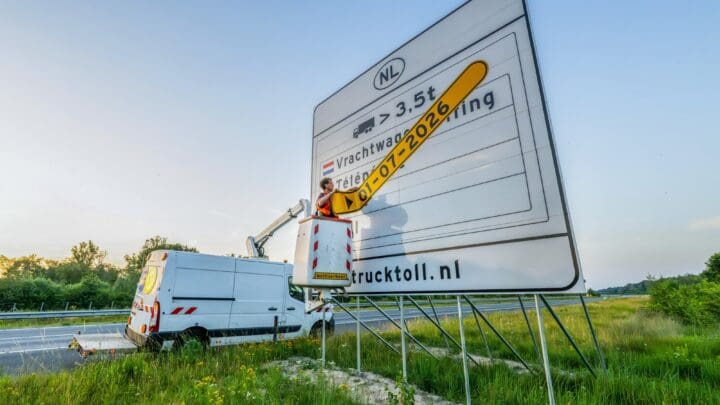
The toll applies to almost all Dutch motorways, as well as a number of provincial and municipal roads. At the same time, the Eurovignette has been abolished in the Netherlands and fixed charges for trucks have been reduced. The levy is recorded through an active on-board unit (OBU) linked to a contract with a toll service provider.
Vincent Karremans, Minister of Infrastructure and Water Management, said: “After years of preparation, the truck levy comes into effect. The vast majority of the revenue generated by this levy will be reinvested in the sector. Through this so-called ‘reinvestment’ mechanism, the sector will be able to electrify more quickly. Ultimately, this not only makes good business sense for transport operators, but also helps improve air quality and reduce CO2 emissions.
“In addition, the crisis surrounding the Strait of Hormuz has demonstrated how important it is to strengthen our energy independence. This measure also contributes to that objective.”
With the introduction of the truck levy, road users will pay according to the number of kilometres they drive. The cleaner and lighter the vehicle, the lower the charge per kilometre.
At the same time, the Eurovignette has been abolished in the Netherlands. In addition, the motor vehicle tax (MRB) has been eliminated for trucks weighing up to 12,000 kg. For heavier trucks, the motor vehicle tax has been reduced to the European minimum level. Furthermore, these heavier vehicles will temporarily benefit from a zero-tax rate from 1 July 2026 until 1 January 2027.
A temporary 22.3 percent reduction in truck levy rates will apply from 1 September 2026 through 31 December 2026 in response to the sharp increase in fuel costs resulting from the conflict in the Middle East.